


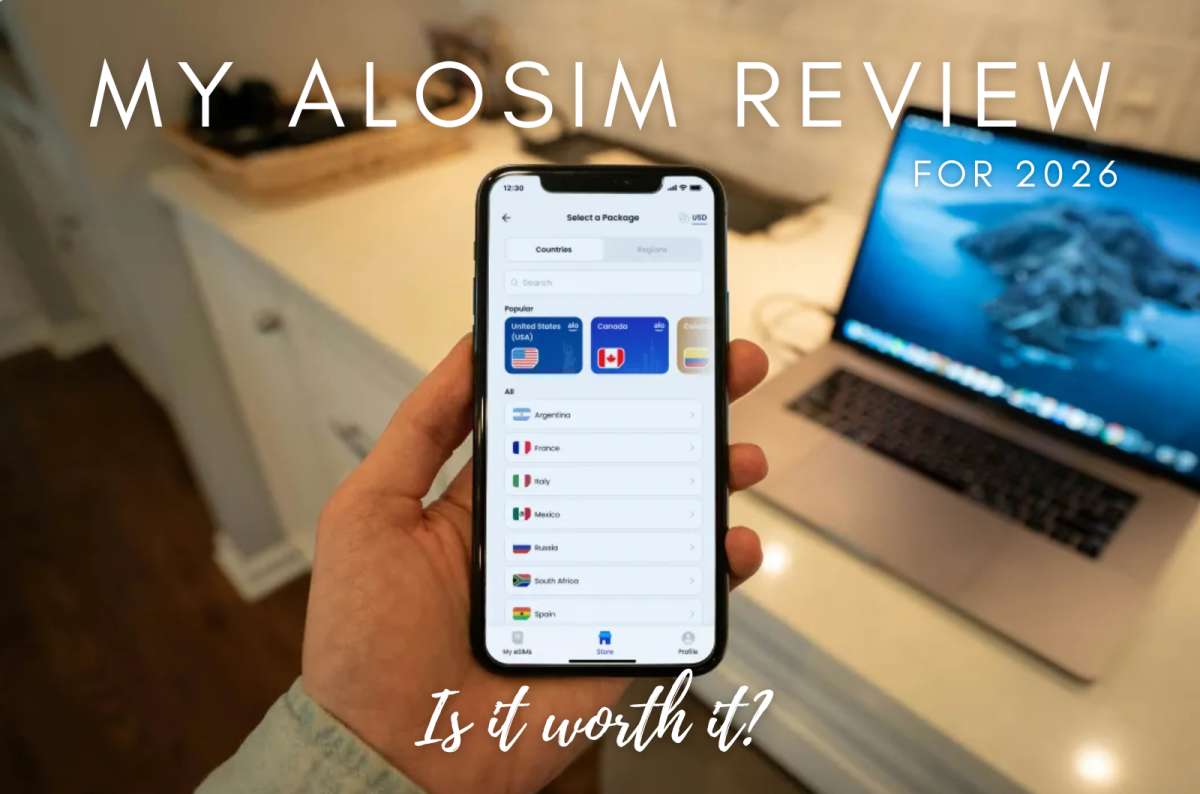


If you traveled to another continent before 2010, you know what trouble it was traveling without data or dealing with the hassle of buying a new SIM card after landing, when you had exactly three attractive options:
Then eSIM providers entered the game, and to this day I still consider them a game changer. Not so much because they dramatically reduce the total cost of a vacation, but because they make traveling considerably easier.
You land, switch on the eSIM, and have instant access to mobile data. No plastic card, no searching for a phone shop, and ideally no financial trauma waiting on your next phone bill.

I want working data when traveling—not a cultural exchange with an airport SIM card salesman.
It’s not even a question to answer. The answer is a resolute yes.
eSIMs changed international travel forever. Having maps, hotel reservations, transport information, translation, and the ability to contact somebody immediately after landing is no longer a luxury. It’s basic travel infrastructure.
After using eSIMs on dozens of trips, I wouldn’t voluntarily return to physical tourist SIM cards. I already have enough unnecessary problems when traveling without deliberately creating another one.
My standards are unnecessarily high for someone reviewing a travel data app, but mediocrity still annoys me—even when the product costs less than dinner.
So I’ll go through the parts that actually matter: price, app design, installation, everyday usability, and whether aloSIM deserves your money (and a place on your phone).
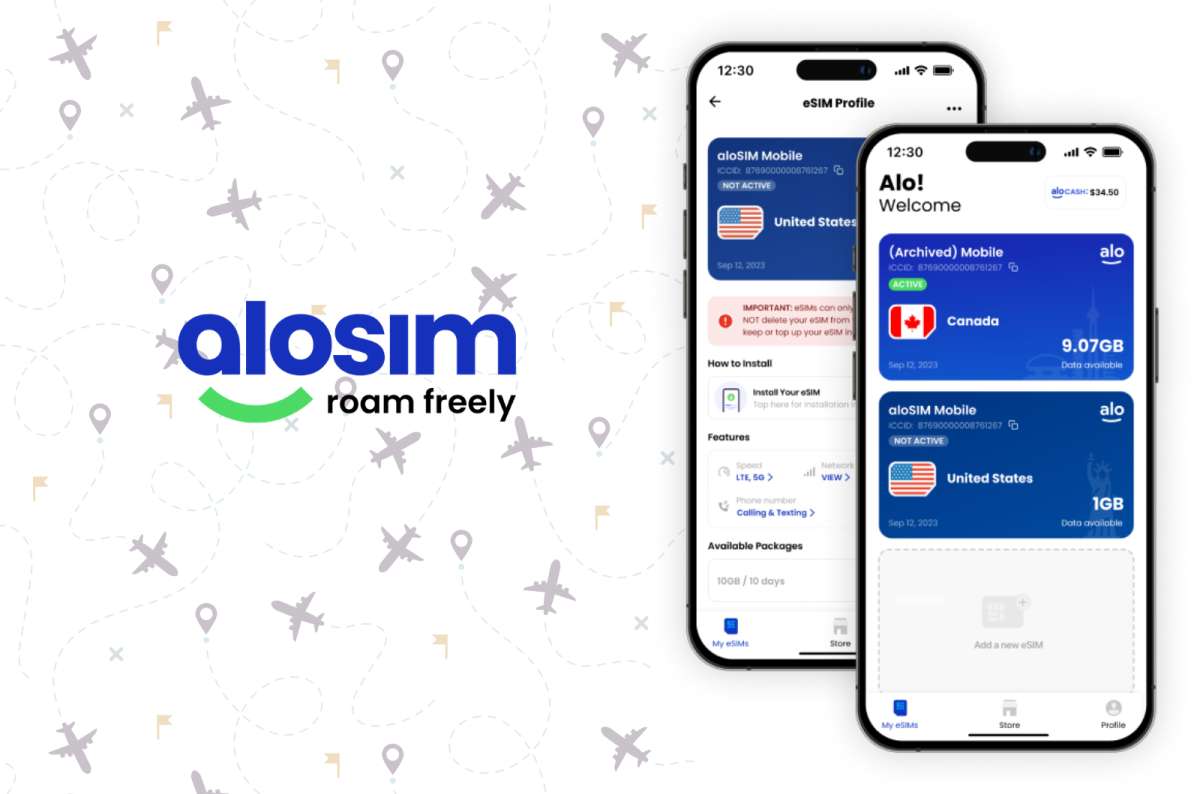
aloSIM gets the important part right—the app is clear, quick, and almost impossible to misunderstand
This is the actual question you stumbled upon my article to answer.
I first started using travel eSIMs because they removed one of the most annoying parts of arriving in another country. Since then, I have tried several providers and learned that most of them sell a fairly similar product.
The real differences are usually price, network partners, and how much unnecessary suffering the app creates during installation.
I tested aloSIM using a Czech Republic eSIM plan because it gave me the easiest comparison with my regular European mobile tariff. I could judge whether the connection behaved normally instead of pretending that seeing one signal bar in a foreign country is scientific research.
So, is aloSIM worth it?
Yes—especially if you care about a stupid-proof app and easy installation.
My quick aloSIM ratings:
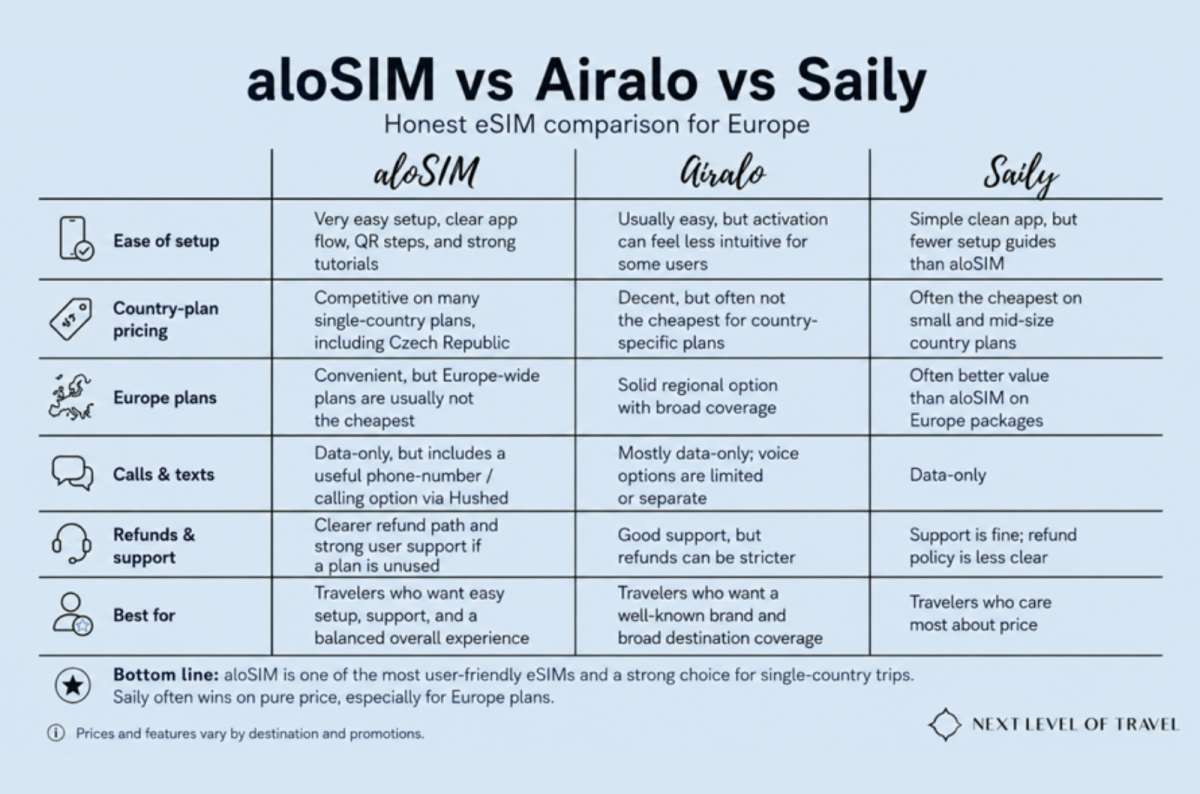
aloSIM is definitely among the cheaper eSIM providers for some individual countries, although it isn’t consistently the cheapest.
Its regional European packages are considerably less convincing. This is where competitors can undercut it.
But for someone who is lazy and not the best with technology, it's just perfect.
Where aloSIM truly excels is the app, checkout, and installation process. It took me around two minutes to buy and install the eSIM. Most of the technical work was handled automatically by my iPhone thanks to their handy auto-installation feature.
This is the provider’s strongest argument. Not revolutionary pricing. Not magical data. Just an exceptionally easy experience with almost no opportunity to screw it up.
And with my technical talents, that is high praise.
Check current aloSIM plans and prices yourself.
You can see aloSIM prices before registering, which should be normal but somehow still deserves praise
That’s the million-dollar question, isn’t it?
Luckily, an aloSIM package costs considerably less than a million dollars. But whether it offers good value depends heavily on where you’re traveling and whether you need a single-country or regional plan.
One thing I immediately liked was that aloSIM shows its prices before registration.
You don’t need to surrender your email address, create a password, verify your blood type, and accept 14 newsletters just to learn how much 5 GB costs.
You can even buy an eSIM without creating a traditional aloSIM account.
That sounds like a small detail, but it isn’t. It removes friction at exactly the moment when most people are deciding whether to buy.
Most eSIM providers can realistically compete in only a few categories:
aloSIM is very strong in the second category.
In the third, the answer is mixed.
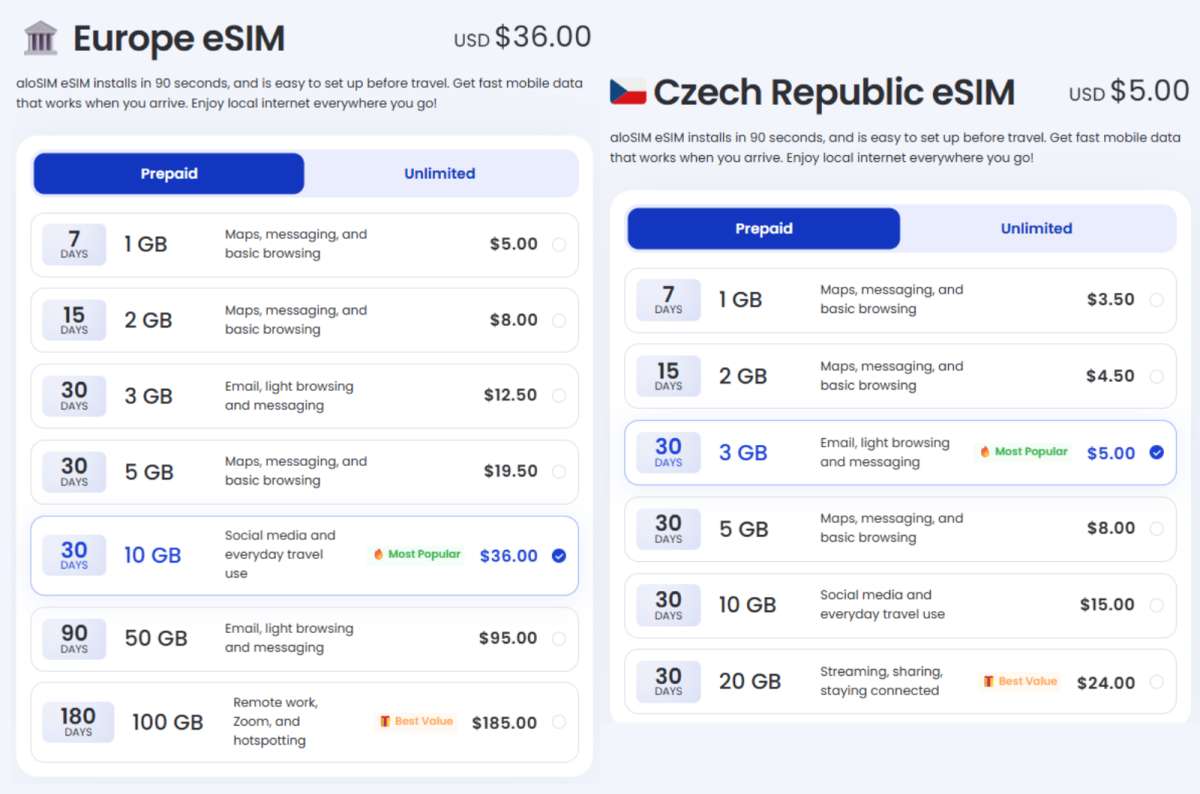
For the Czech Republic, aloSIM is genuinely competitive.
Its standard Czech packages cost USD 3.50 for 1 GB, USD 5 for 3 GB, USD 8 for 5 GB, USD 15 for 10 GB, and USD 24 for 20 GB.
Saily is roughly about a cent cheaper across most regular package sizes, if saving a penny is a dealbreaker.
For 3–10 GB, I wouldn’t choose between aloSIM and Saily purely because of a difference of a few cents. The easier app can be worth more than that—especially when you’re buying the package before a trip and don’t want another technical project.
Ubigi becomes much stronger for large amounts of data. Its 50 GB and unlimited packages make aloSIM’s high-consumption options look a bit less attractive.
For a small package, Saily is usually cheaper.
For 3–20 GB, aloSIM remains competitively priced.
For heavy data use, Ubigi is the stronger option.
And for unlimited data, aloSIM looks fairly expensive compared with Ubigi.
For a single-country Czech eSIM, I’d give aloSIM 8/10 for price competitiveness.
It’s fair to describe aloSIM as one of the cheaper choices here. Calling it the absolute cheapest would be marketing creativity rather than mathematics.

Whether it's Luxembourg or somewhere else in world, I just want the data to work the second I land
Unlimited data is more evenly priced across the market.
aloSIM charges around 27 USD for 7 days, 35 USD for 10 days, and approximately 49 USD for 15 days.
That is broadly in line with Airalo and Holafly. Nomad can be a bit cheaper, particularly on shorter unlimited packages.
Here, aloSIM isn’t cheap enough to disrupt anything, but it also isn’t offensively overpriced.
It sits around the standard market price.
I’d rate aloSIM’s unlimited European pricing 7/10.
The overall pricing can therefore be summarized quite simply:
aloSIM is competitive for individual European countries, especially small and medium data packages, but it is not the cheapest option for multi-country European plans or heavy data users.
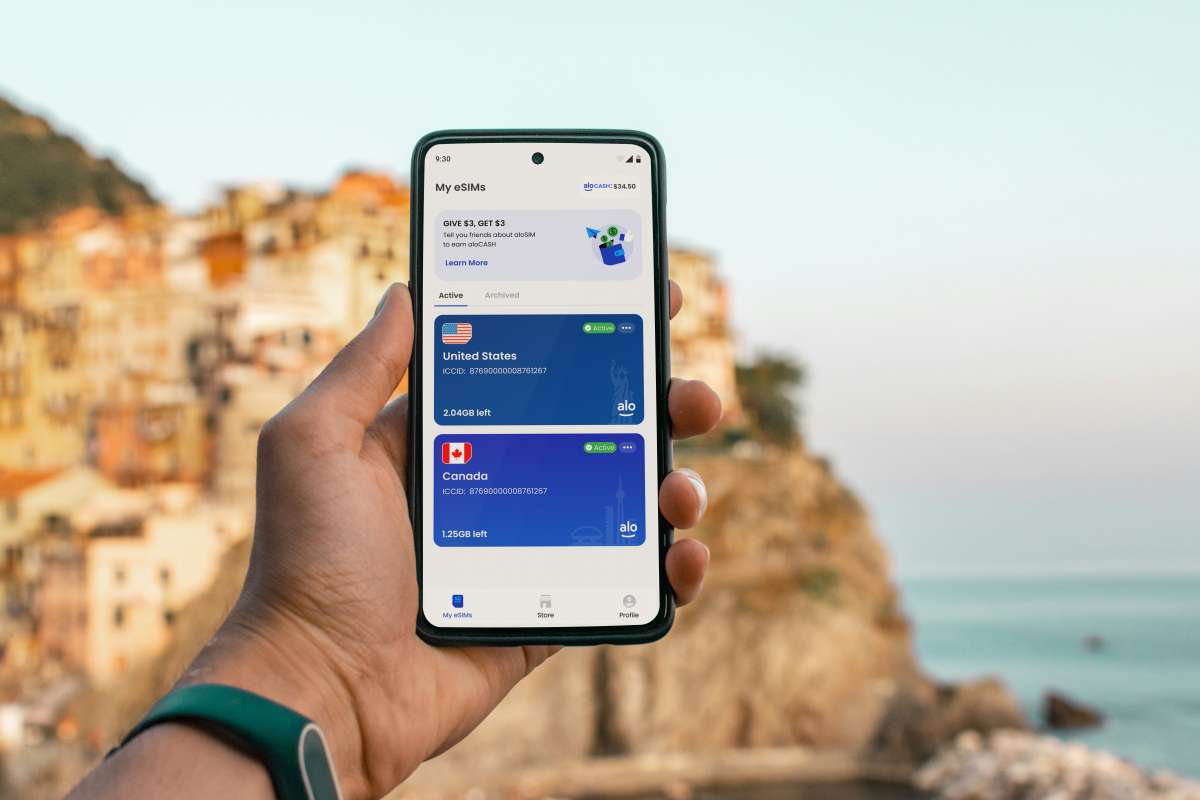
Another super important part of any application or eSIM provider is its design, familiarity, and ability to tell you what to do without requiring a degree in telecommunications.
I honestly liked it.
The app is clean, logical, and considerably less confusing than many travel products that have apparently been designed by people who never traveled while tired.
All the important information is where I expected it to be. I could browse destinations, see the available packages, check prices, complete the purchase, and move into installation without bouncing between random menus.
More importantly, the app is localized into Czech.
That surprised me.
Czech is not exactly the first language international technology companies usually prioritize. The translation is useful because the app follows the phone’s system language, making it much easier for somebody who is less comfortable using English.
There is one tiny drawback: I couldn’t find a manual language switch inside the app.
At first, I thought I was missing a setting. I later realized that aloSIM simply uses the iPhone’s language setting.
This is convenient until you need English screenshots for an article and your entire app is stubbornly Czech. A highly specific tragedy, admittedly, but still a limitation.
And if something does trip you up, there's an actual help menu waiting, not just a "sorry, try again" wall
The navigation is aloSIM’s strongest feature.
You can inspect plans before registering, and the checkout does not suddenly turn into an administrative procedure.
The whole route from choosing the destination to installing the eSIM felt almost frictionless.
I wouldn’t describe myself as technologically helpless, but I also don’t enjoy spending 20 minutes reading instructions to activate mobile data.
With aloSIM, I didn’t need to.
The app tells you what is happening, the iPhone handles most of the installation, and there are very few moments when you can choose the completely wrong option.
For normal users, this is good UX.
For technically challenged users, it may be the main reason to pick aloSIM over a slightly cheaper competitor.
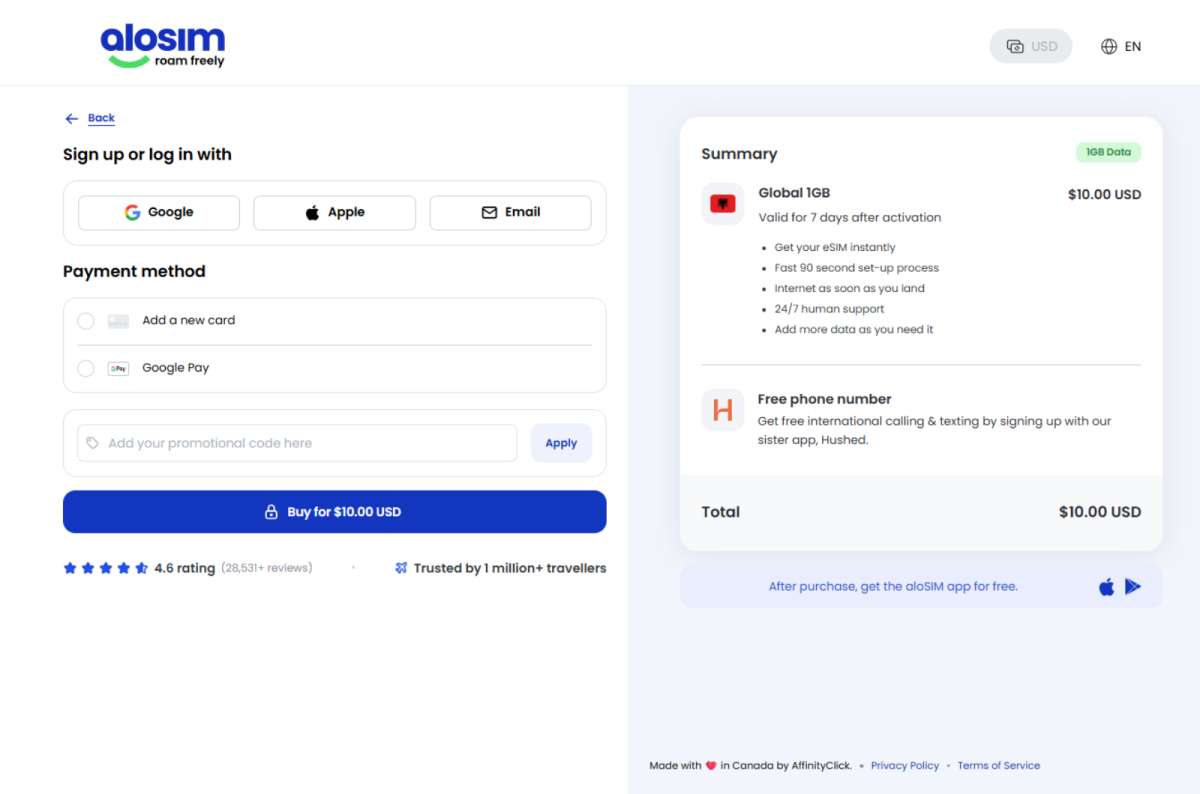
No account creation wall, no 15-step form, just pick a login and pay
What is payment doing in the design section?
Because I consider a simple, transparent checkout both a design feature and an engineering decision.
aloSIM supports the usual payment methods, including Apple Pay. That made the purchase considerably faster because I didn’t need to type card information into my phone like it was 2012.
I used Google to log in, as I usually do.
Google and Apple ID login options are both available, and the process was very quick. You can also complete the purchase without going through a long traditional registration process.
From opening the app to owning the eSIM, it took me around two minutes.
That is exactly how travel technology should work. I want to buy data, not form a long-term emotional relationship with an onboarding form.
For design and UX, aloSIM gets 10/10.
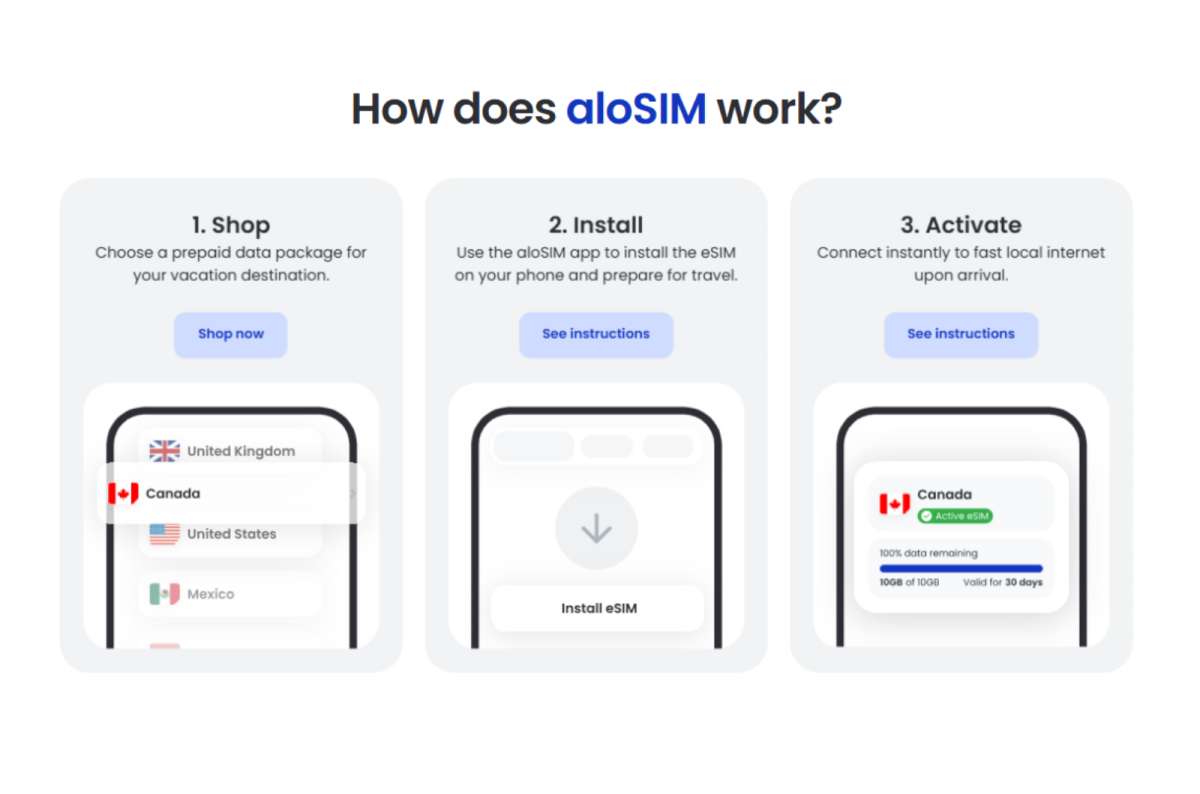
Three steps, and step two is basically "wait for a progress bar"—it's that easy
Now we arrive at the grueling part of the eSIM world—the moment when older users, nervous users, and people who don’t enjoy changing phone settings may consider giving up.
With aloSIM, there wasn’t much suffering.
I selected the Czech Republic plan, paid through the app, and started installation. My iPhone handled most of the technical steps automatically.
The entire purchase and installation took me around two minutes.
It was so easy that describing it in detail almost makes it sound more complicated than it was.
Yes.
Once you start the installation, the iPhone walks you through the process. You mainly confirm the steps and let the device add the eSIM.
There is very little manual configuration, and the whole thing is almost aggressively idiot-proof.
This is where aloSIM beats many competitors.
A provider can save me USD 1 on data, but if its setup instructions make me wonder whether I have accidentally disabled my normal phone number forever, that dollar suddenly doesn’t feel important.
For setting up and installation, aloSIM gets 11/10.
I strongly recommend buying and installing your eSIM while you’re still at home.
Yes, you can do it at the airport. I have done that before using crappy airport Wi-Fi, and it is exactly as enjoyable as it sounds.
You’re already checking the gate, watching your luggage, dealing with security, and wondering whether your flight will leave on time. Adding an eSIM installation to this situation creates completely avoidable stress.
Install it before the trip when you have stable Wi-Fi and enough time to check the settings.
The installation itself is simple, but you still need an internet connection to complete it. Depending on unreliable airport Wi-Fi for the thing that is supposed to give you reliable internet is a slightly ridiculous circle.
My rule is simple: buy and prepare the eSIM at home, then switch to it when needed.
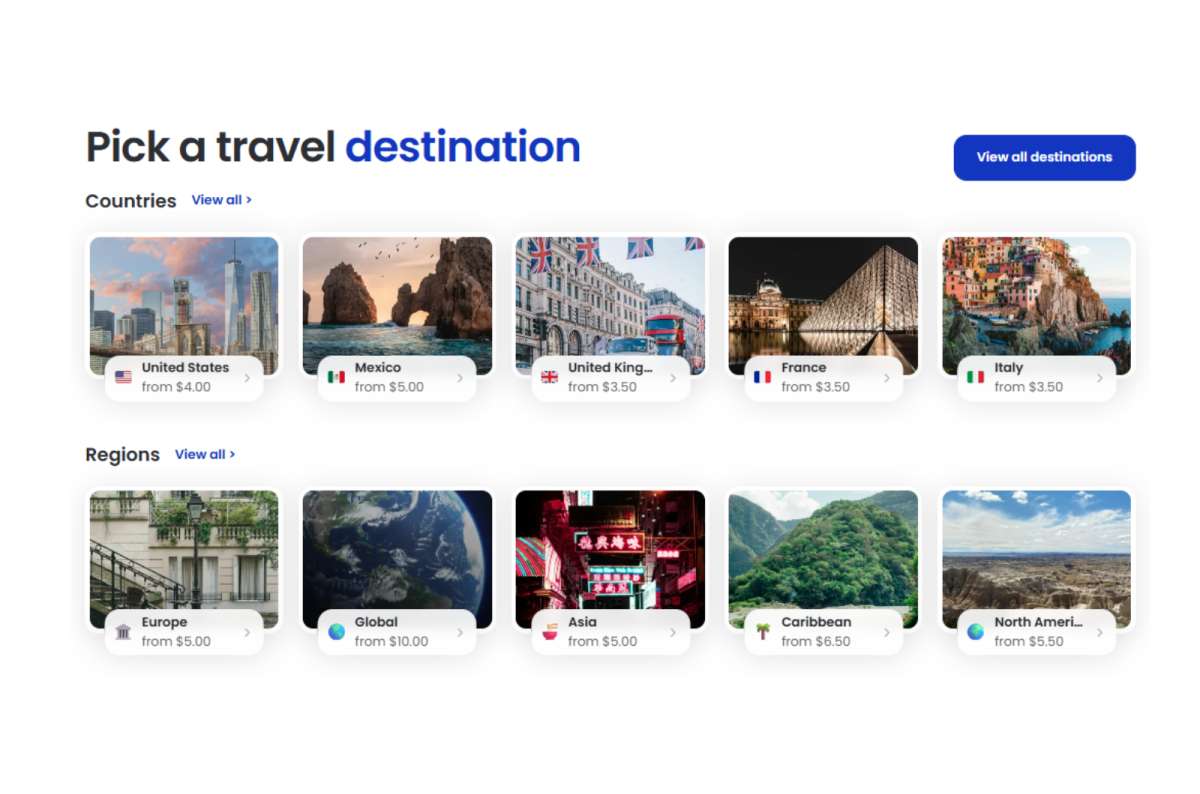
Countries or whole regions, pick your scope before you even open your wallet
I tested aloSIM using a Czech Republic plan.
This was the most useful comparison because I already know how mobile data normally behaves here. Testing it somewhere completely new would make it harder to separate aloSIM performance from ordinary local network coverage.
During my use, the eSIM behaved as expected.
The connection worked for normal phone use, browsing, maps, messages, and the basic tasks I’d need while traveling.
I didn’t notice anything that made the experience feel fundamentally different from regular mobile data.
And that is precisely the point.
The best eSIM experience is not exciting. It simply works and disappears into the background. That’s exactly what aloSIM did.
I wouldn’t choose aloSIM because it somehow produces magical premium internet. The underlying connection still depends on its local network partner and available coverage.
I’d choose it because purchasing and installing the plan requires almost no effort.
For data and everyday usability, I give aloSIM 9/10 based on my test.
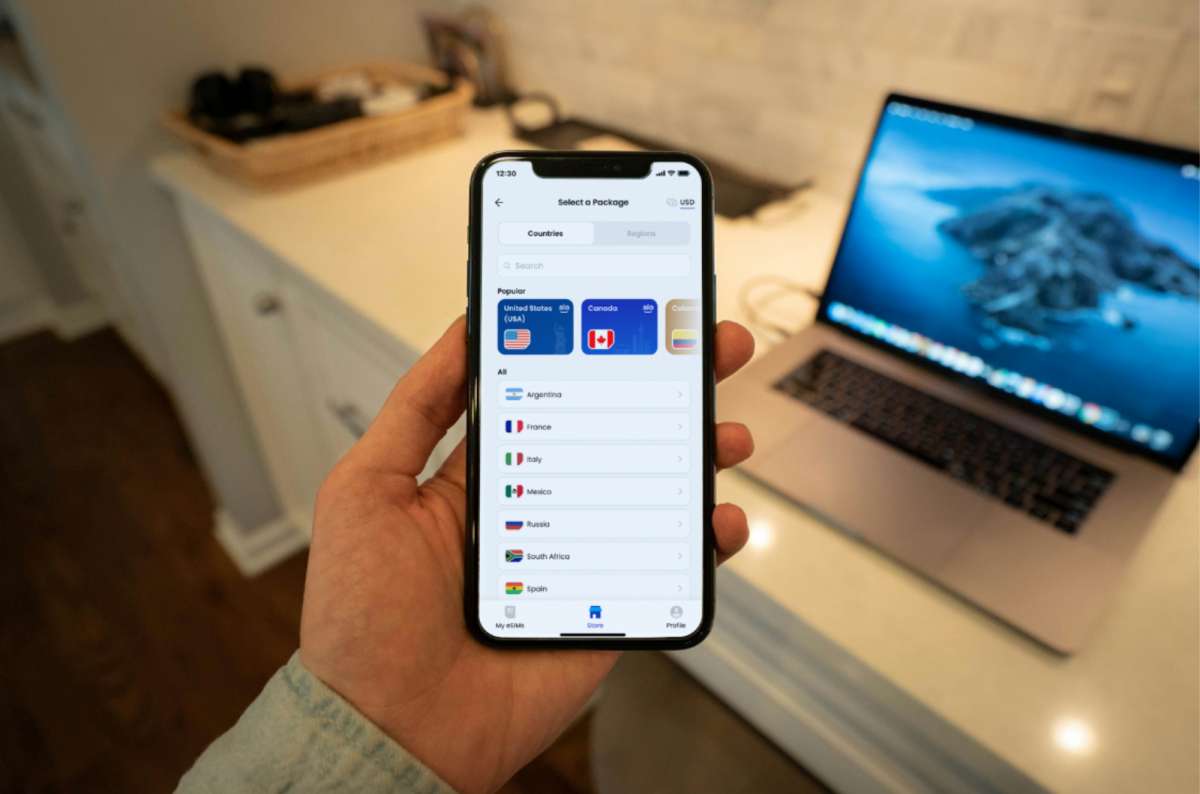
Check out the aloSIM website yourself!
I’d recommend aloSIM primarily to travelers who care more about easy setup than saving a dollar.
It is also a strong option for people who aren’t confident about changing mobile settings, iPhone or Android users who want a largely automatic installation, and travelers buying small or medium single-country packages.
The ability to see prices without registering is useful, and the Google, Apple ID, and Apple Pay options remove most of the usual checkout friction.
aloSIM makes the most sense when convenience and a stress-free setup matter.
For some people, the easiest app is more valuable than the absolute cheapest package.
I am increasingly one of those people.
I’d compare alternatives if you consume 20–50 GB or more, need the cheapest unlimited option, or are willing to compare several providers for every destination.
aloSIM may still win for your destination, but assuming that it will is how people end up paying USD 36 for 10 GB when they don't need to.
So, is aloSIM worth it?
Yes, with one major condition: choose it for usability and a smooth installation process, not because you assume it is always the cheapest.
aloSIM delivered one of the easiest eSIM purchase and installation experiences I have tested.
I could view prices without registering, log in with Google, pay through Apple Pay, and install the eSIM in approximately two minutes.
Most of the process was handled automatically by my iPhone. Even somebody with limited technical confidence could manage it.
For individual countries—particularly small and medium data packages—aloSIM is competitively priced. The differences from cheaper providers are often small enough that I’d happily pay them for the superior UX.
My final positioning is therefore simple:
aloSIM is one of the easiest eSIM providers to use and a competitive choice for individual countries, but it is not always the cheapest option for multi-country plans or heavy data users.
I’d use it again for the right destination and package.
I just wouldn’t stop comparing prices because the app has successfully seduced me with competent design.
Here you can check out the current aloSIM plans.
This post contains affiliate links. If you make a booking through one of my links, I may earn a small commission—at no additional cost to you. Thank you for your support!


Hi, I’m Jan. I travel fast and intensely, whether I’m exploring the buzz of Tokyo in 3 days or road-tripping through mountains and beaches on a 3-week Thailand adventure. And no matter where I am, you’ll always find me in a comfortable hotel at night and eating the best food.
If that sounds like your kind of journey, hop on board, and let’s explore the world together!
I started this blog after realizing how tough it can be to find reliable, authentic travel info. You wouldn’t believe how many “travel bloggers” never even visit the places they write about! On Next Level of Travel, you can count on my full honesty and insights drawn from my firsthand experiences.
Here’s the deal: not every destination is all superlatives and unicorns. I’ll let you know if a tourist attraction isn’t worth your time, like skipping overrated stops in my 2-week Spain itinerary. And when I find something truly special—like the perfect mix of culture and nature in Cape Town—you can trust that it’s worth adding to your itinerary.




Comments | Thoughts? Give us a shout!