


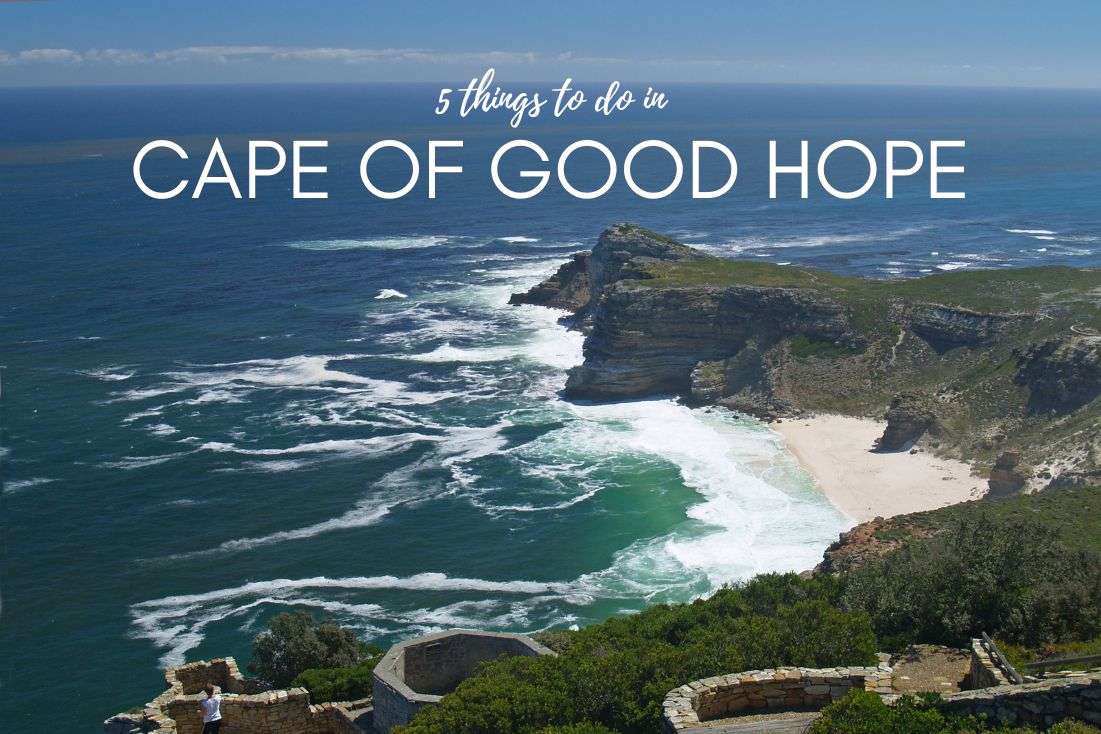


Cape of Good Hope is the number one destination in South Africa! It might not be the southernmost tip of the African continent, but it’s mesmerizing and packed with unforgettable things to do in Cape of Good Hope. Which trails are the best? How did the Flying Dutchman get there? And where are the best beaches? Let me tell you, based on my own experience during multiple trips.
Read more from my South Africa travel blog.
I’ve ranked the best things to do in Cape of Good Hope based purely on how much I enjoyed them—not what the generic travel blogs say. Below, I’ll describe each one properly and tell you what it’s actually like and why I loved it. Note: Make sure to rent a car in South Africa! It’s the best way to see all the highlights at your own speed.
My tip for eating in Cape of Good Hope:
Tiger’s Milk Muizenberg
You might also be interested in reading:
Mandatory Photoshoot
Now that we've cleared that up, let’s move to the actual visit. Cape Point is a National Park. That means there is a ridiculously small entrance fee and nice, clean facilities on the site.
We arrived at the main parking lot with a restaurant and the funicular railway station, which is basically in the center. Most visitors start their Cape Point experience here. It’s about a 1.5-hour drive from Cape Town, making it an easy day trip.
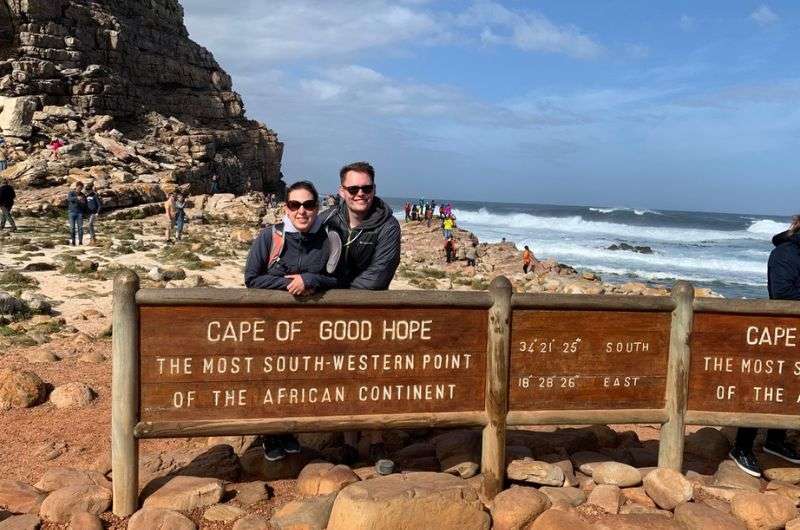
We decided we needed to visit the Cape of Good Hope first, and so we took the short trail down the cliffs. There are wooden or stone paths everywhere, and it is all visible from a distance, so even the biggest idiot gets there safely. As I saw the wooden sign at the beach at the end of the trail, I knew we’d reached the end. After several attempts to get the best Insta-shot, preferably without other people (impossible), we headed back to the parking lot.
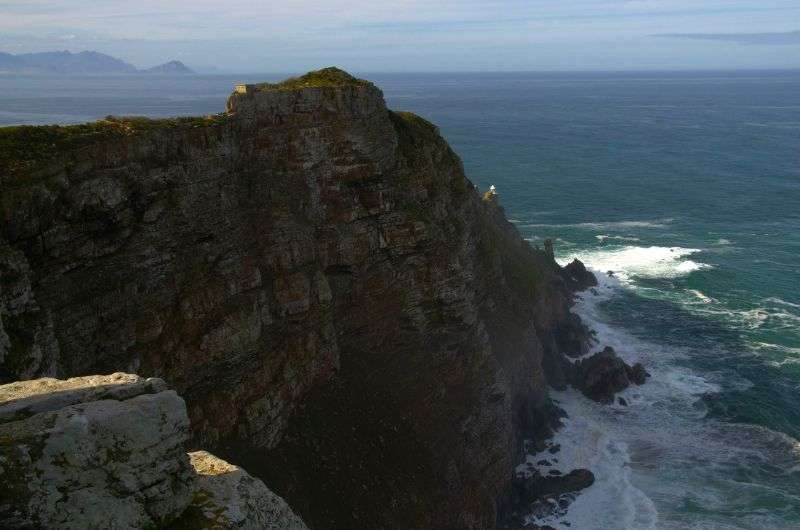
The feeling, when you're standing at the end of the world in Table Mountain National Park...
You can see the old lighthouse right from the parking lot, but that’s not the only one. I love to do my research in advance, so I knew that this spot wasn’t exactly the best (all the dead sailors could tell), so they decided to build a new one further on the cliff. But first things first.
There are three ways to get to the old lighthouse:
It’s not very hard to get to the top, but it might be rough for those who are out of shape. Karin and I were alright, but on this trip, I decided to treat my mother to a nice vacation (by the way, trust me, it’s not a good idea if you want to maintain good relations with your parents), and she had a hard time climbing the stairs at the end.
Nevertheless, the scenery is so stunning and amazing, you’ll be stopping every now and then to soak it in anyway.
It’s the most romantic place I’ve ever been to, in a Wuthering Heights kind of sense. The rugged cliffs, strong wind, and roaring ocean would make a perfect setting for a period piece. For the ultimate breathtaking experience, take this trail.
This hike connects the old and the new lighthouse and lets you explore some of the best possible scenery. We walked to the end of the Cape Peninsula and just stood there in awe. Below us are only sheer cliffs dropping down 300 m (980 ft) into the ocean. The vast ocean waters stretch the horizon, and you realize there is only the Antarctic on the other side of the mass… mind-blowing.
The funicular railway gets you up to the new lighthouse in a short 3-minute ride, and it’s barrier-free. Now you’re surely curious about the name. It would be weird if an amazing place like this, with countless shipwrecks along the coast, wouldn’t inspire any telltale.
There’s one about the Dutch galleon from the 17th century. Captain Hendrick van der Decker supposedly didn’t want to turn back despite the storm and decided to sail around the cape. When all of a sudden, an angel appeared on the deck, and the furious captain shot her. From that day, the crew is condemned to sail through these haunted waters every day over and over again.
Funny thing is that countless fishermen and sailors have reported seeing the ghostly galleon with its crew seeking someone who would help them deliver their letter home to their families. Everyone who approached them ended up dead, though. Bummer. Anyhow, the funicular should be safe.
Opening times are the same as for the National Park.

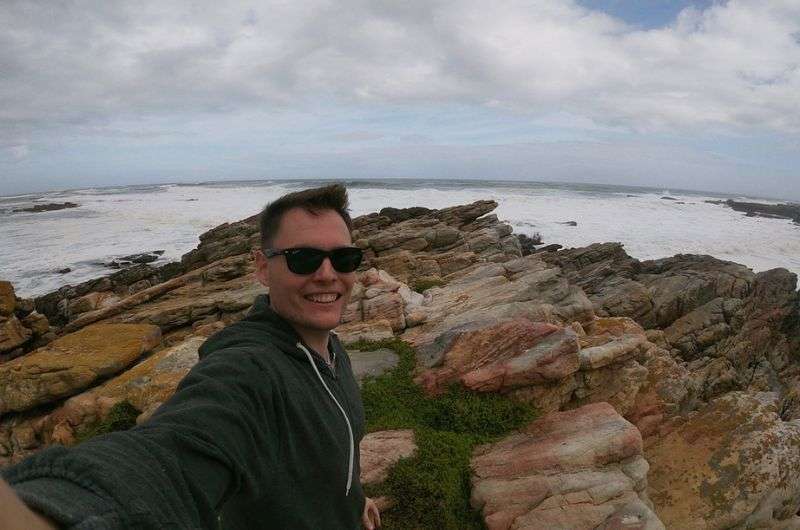
I'm imagining myself as a Heathcliff
One of the most beautiful beaches near Cape Town, surrounded by large boulders and dramatic cliffs, is to be found around the peninsula. With fine white sand and usually empty, it might be tempting. However, it’s not advisable to swim there—we didn’t. There are strong tides, no lifeguard, and the water is frankly quite cold. But it’s a nice walk with majestic scenery.
So, forget about swimming, but you can draw your names in the sand or take a cheesy couple of photos, or do any other crazy stuff people are doing these days. Or... you can make a reenactment of the famous Jake and Rose door-scene, I think that you wouldn’t even have to act, you’re freezing. Personally, I’m okay with a walk. Here is a list of the best beaches in Cape Point:
Talking about beaches, I totally dig the shipwrecks there. It’s thrilling when you’re walking on the beach and explore the hundred-year-old torso of a ship. The hiking trails lead through the thick fynbos, which makes it a pleasant walk even without the wrecks. There are two trails, both starting at the Olifantbos parking lot. I must say it’s all very well marked, so visitors couldn’t stray off from the road unless they do it on purpose.
This is the shortest and most accessible one. It’s marked by yellow and leads you down to the beach towards the wreck of SS Thomas T. Tucker. The US ship was built during World War II to carry troops and weapons, but in 1942, the ship was wrecked on these shores trying to avoid German detection boats. Since then, the local birds seized the wreck and declared it their territory.
We decided to continue on the Sirkelsvlei Trail. This loop trail leads through various landscapes from rugged cliffs and sandy beaches to Sirkelsvlei pan, home to many rare animals such as bontebok and hartebeest.
If you’re lucky, you can even spot an ostrich. And of course, several shipwrecks. I mean, if I were a boy, I would spend the entire afternoon discovering the shipwrecks. For a family afternoon, take this as a warning... or a recommendation. It depends on how much time you are willing to spend there.
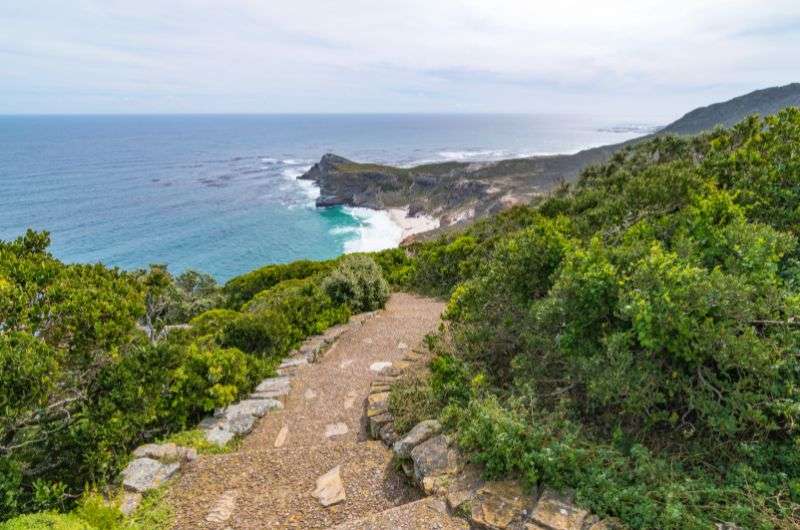
Diaz Beach
The Cape of Good Hope, located in Table Mountain National Park, is part of the Cape Floristic Kingdom. Like Table Mountain, the Cape is home to hundreds of indigenous endemic plant species. The characteristic of this area is the endemic fynbos, an evergreen shrubland.
I’m not much of a flower guy, but this is like from another world—an amazing contrast to what we know from Europe or the US. Apart from the flowers, you can admire a bunch of animal species: lizards, snakes, birds, tortoises, whales, and even antelopes and mountain zebras. And the sneakiest ones: baboons (more about those bastards later).
Technically, it’s not Cape Point, but it’s in Simon’s Town, halfway on the way back to Cape Town. Boulders Beach is home to colonies of African penguins, endemic to the southeast of Africa. You don’t need a map, just go for the smell. That’s awful, to be honest, but the penguins are cute and funny to watch.
Just remember, they have endangered species and still wild animals. Don’t disturb them and don’t try to pet them. Boulder's Beach is one of the most popular wildlife stops near Cape Town.
The weather at Cape Point, just outside Cape Town, is rough as well as its waters. Exposed to the Atlantic winds sweeping down the peninsula past Hout Bay, this stretch of coastline can feel especially wild. There are strong coastal winds, and especially in the winter months (June to August), it gets a bit chilly.
It might be a good idea to pack a light jacket. After the whole day there, we felt like after a whole day skiing—with weathered faces and weirdly exhausted (although the hikes are not so challenging).
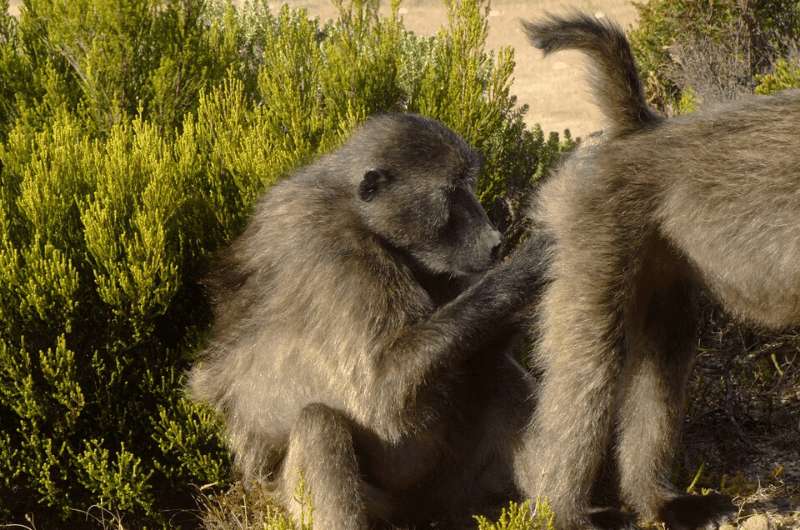
Shameless creatures...
Last but not least, the baboons! They are cute from the safety of the car, but far less cute when you step out of it. Karin wanted to take a cute, funny photo with these rascals, but ended up too scared to approach them closer than 5 feet.
I tried, but they know the alpha male when they see one, so they scattered. And as any other monkey, rude and bold. They are attracted by food, and they steal everything that isn’t chained to your body.
If you don’t watch your bag, it will be lost faster than Nixon’s career after Watergate. And when that happens, believe me, you don’t want it back anymore. These bastards have long, sharp canine teeth fit to kill you in a matter of seconds. But in some ways, the baboons are the same as people…kinky.
Everyone lied to you! Yes, the Cape of Good Hope is not the southernmost point. It is Cape Agulhas, that’s the place where the Atlantic and Indian Oceans officially meet. I’m telling you, it’s steamy. No, seriously, it’s a pretty cool experience to put each foot in a different ocean. But back to Cape of Good Hope.
Nowadays, when we know all that stuff, all the brochures, and signs mark the spot as “the most south-western point”. Well, it’s not the same.
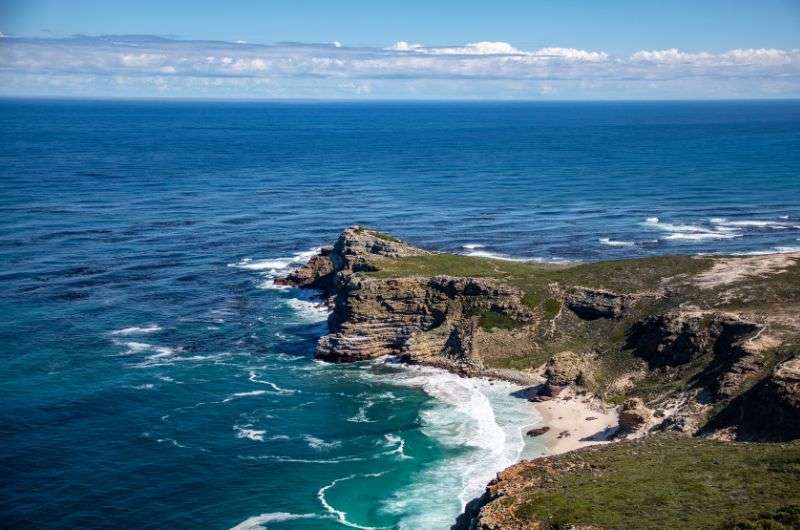
The view of the Cape of Good Hope from Cape Point
Sneaky liars, those high school teachers… Let’s get it straight. Yep, Bartolomeu Dias was the guy who “discovered” it and shaped its maritime history. But it was on his way back to Portugal, and he originally named it “the Cape of Storms”, rightfully to be honest.
The traitorous currents and strong winds have caused countless shipwrecks. But the Portuguese King didn’t like that very much, because he was a smart guy and he realized this was not the best marketing copy for the trading route to India. To enhance the trading route development, he decided to rebrand the Cape name for something optimistic. Hence, the Cape of Good Hope.
Ha, even more confusion. The Cape of Good Hope is located on the Cape Peninsula in the western part of False Bay in South Africa. But there are two capes at the end of the Cape Peninsula.
If you look at it, the Peninsula looks a bit like a chicken leg, where the Cape of Good Hope represents the left side of the joint and Cape Point the right one. But, to bring more chaos into it, the Cape Point National Park is also the name of this entire southern area belonging to Table Mountain National Park.
This post contains affiliate links. If you make a booking through one of my links, I may earn a small commission—at no additional cost to you. Thank you for your support!


Hi, I’m Jan. I travel fast and intensely, whether I’m exploring the buzz of Tokyo in 3 days or road-tripping through mountains and beaches on a 3-week Thailand adventure. And no matter where I am, you’ll always find me in a comfortable hotel at night and eating the best food.
If that sounds like your kind of journey, hop on board, and let’s explore the world together!
I started this blog after realizing how tough it can be to find reliable, authentic travel info. You wouldn’t believe how many “travel bloggers” never even visit the places they write about! On Next Level of Travel, you can count on my full honesty and insights drawn from my firsthand experiences.
Here’s the deal: not every destination is all superlatives and unicorns. I’ll let you know if a tourist attraction isn’t worth your time, like skipping overrated stops in my 2-week Spain itinerary. And when I find something truly special—like the perfect mix of culture and nature in Cape Town—you can trust that it’s worth adding to your itinerary.


Comments | Thoughts? Give us a shout!