





Dubbed the City of Gold, Johannesburg is the largest city in South Africa and one of the most important urban hubs in southern Africa. If you're looking for the best things to do in Johannesburg, you’ll quickly discover it’s also home to the Hillbrow Tower, the tallest telecommunications tower in Africa, one of the world’s largest hospitals (The Chris Hani-Baragwanath Hospital) and the busiest airport on the African continent (Johannesburg Airport, officially OR Tambo International Airport)
Most travelers arrive via Tambo Airport, the main international gateway to Johannesburg and the rest of the country.
As if that wasn’t enough, it’s also the wealthiest city in Africa and has the world’s largest urban forest with 10 million trees—one of the many reasons Johannesburg is such a fascinating city to explore.
Read more from my South Africa travel blog.
No. You’d think it would be the country’s capital city. Or, considering South Africa has no less than 3 capital cities, it is surely one of the three, right? Nope. I don’t know about you, but if I were Jozi (or Joburg), I’d be side-eyeing Cape Town, Pretoria, and Bloemfontein quite a bit.
When gold was first discovered here in the 1880s, Johannesburg quickly grew from a mining camp into a new city almost overnight, but it is not a capital city.
Fun fact: Johannesburg is also home to Africa’s tallest completed building outside of Egypt—the Leonardo in Sandton, a 234-meter skyscraper that briefly held the title of Africa’s tallest building after its completion in 2019.
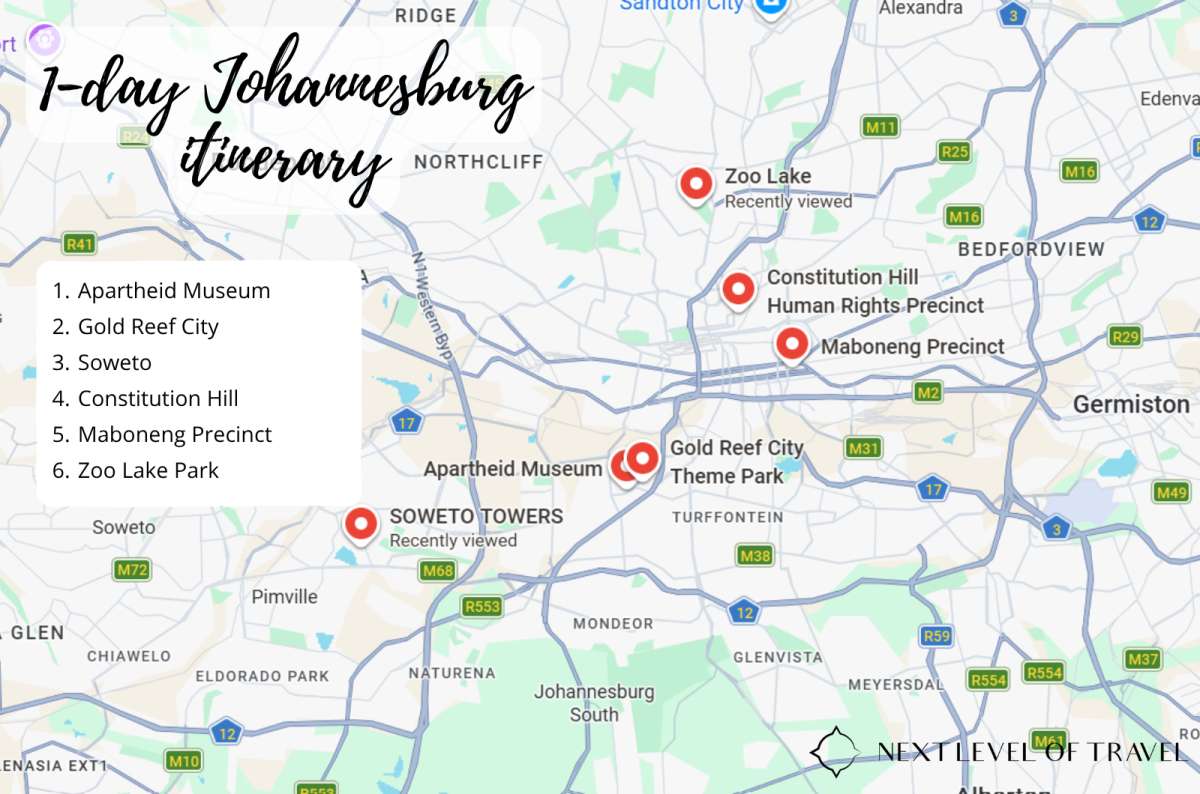
1-day Johannesburg itinerary map with the best things to do in Johannesburg
This is my 1-day Johannesburg itinerary—it focuses on Johannesburg city highlights in the order that makes the most sense. I’ve added the times you need for each spot so you can plan your trip effectively.
The Cradle of Humankind and Pilanesberg National Park are best visited as separate day trips, and I strongly recommend both of them.
You might also be interested in reading:
I have ranked the best things to do in Johannesburg based on how interesting I found them and how much they add to understanding the city. Below is my quick overview—I'll go into the details and my experience with each one further down.
Together, these places cover many of Johannesburg’s main attractions, from historical landmarks to neighborhoods where locals actually hang out.
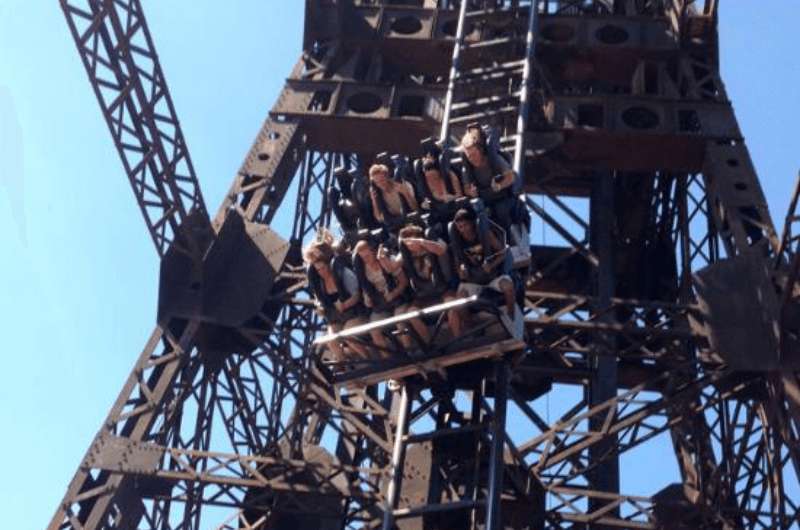
Looks lovely! Tower of Terror
Tip: Free entrance on your birthday!
Start out with a gold mine, a hair-raising ride... and a wedding? Joburg’s gold rush-inspired theme park is a city within a city. The park celebrates Johannesburg’s gold mining roots, which shaped the entire region. Everything started when prospectors discovered gold in the Witwatersrand area in the late 19th century.
There is a casino, shopping, restaurants, and even a wedding chapel. It’s the kind of place where every different guest finds something to do, whether they came for roller coasters or just lunch and a look around.
For something a little educational, take a tour of an authentic gold mine from the era that gave Johannesburg its nickname, the City of Gold.
Or, if you want to test your ability to hold down your lunch, you could drop 49 feet into a mine shaft on the thrill ride called Tower of Terror. At 6.3G, you’ll experience about double the force that astronauts do during takeoff. No other rollercoaster in the world will let you experience more G-force than this little guy. In total, 18 out of the 30 rides are roller coasters, so you can pack on the G’s all day.
Have you had too much fun at Gold Reef City? Are you smiling from ear to ear? Right next door is the sobering Apartheid Museum that will wipe that smile right off. Photographs, films, display panels, and personal documents walk you through South Africa’s complex history and the struggle against the apartheid era, including the story of Nelson Mandela and other leaders of the movement.
Since the country is still recovering from the 40-year oppression of black Africans, understanding Apartheid is something every visitor to South Africa should prioritize.
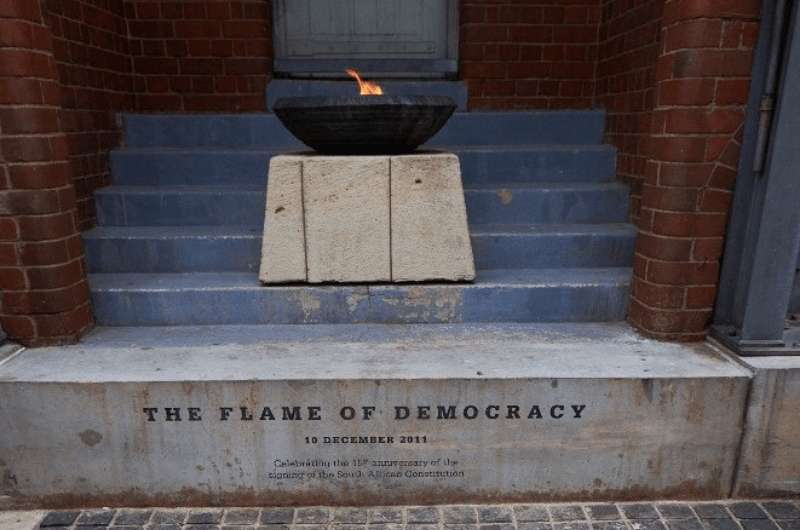
Flame of Democracy at Constitution Hill, a powerful reminder of South Africa’s apartheid history
To further your education in South Africa's rich history, visit Constitution Hill, a former military fort and prison complex.
Political prisoners and passive resistors, among others, were held here in terrible conditions, and walking through the halls lined with massive metal doors and walls with crumbling paint, I dare you not to get chills. Some famous inhabitants were Nelson Mandela, Mahatma Gandhi, and Albertina Sisulu. A guided tour makes the visit much more powerful because the stories behind the cells and court buildings are half the point.
There were four blocks at the prison: one for white prisoners, one for non-white prisoners, a women’s block, and the awaiting-trial block. Today, the Constitutional Court has its seat in the very spot where the awaiting-trial block one stood, with four of the original staircases in and around the court building. One of the staircases holds the Flame of Democracy. This perpetual flame was lit by Nelson Mandela in 2011 and serves as a reminder to South Africans of their right to freedom.

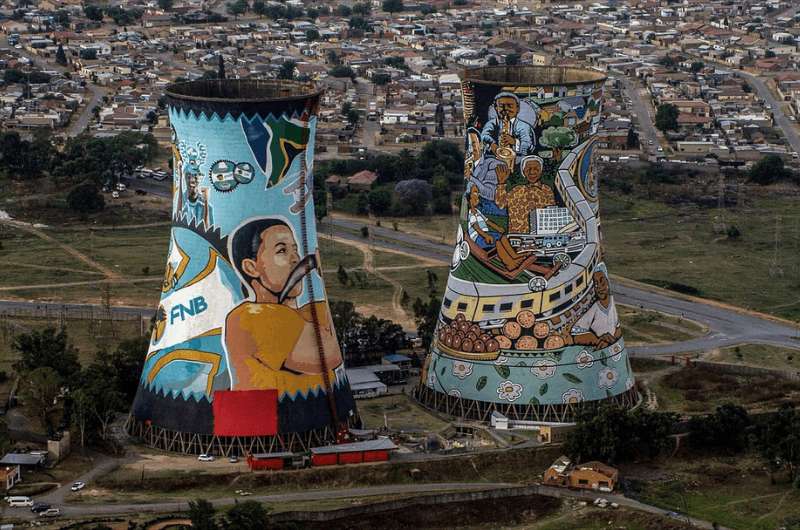
The painted Orlando Towers in Soweto—once decommissioned cooling towers, now colorful landmarks reflecting the area’s local culture
If you want to explore Johannesburg city center beyond the main tourist strip and get a reality check, venture into Soweto township. The area was created by the White government in the 1930s to house Black Africans, since the plan was to remove them from Joburg proper. The conditions local people lived in, and often live in even today, are something to think about. Soweto also housed miners as it was adjacent to the main mining belt. The former miners’ housing can also be seen.
To this day, if you Google Soweto, you will be warned to stay out due to safety reasons. But you can easily and safely tour the town by yourself (just keep your wits about you) if you stick to the main sites: Vilakazi Street with Mandela House and Tutu House, the Hector Pieterson Museum and Memorial, the fantastic Soweto Theatre, or the Orlando Towers (you can bungee jump off one of them, too!).
Not far from here, you can also find Chancellor House, the law office where Nelson Mandela and Oliver Tambo once worked.
To really get a grip on what Soweto was and is about, we highly recommend taking a comprehensive tour. Many tour visits are led by locals who share their personal stories and experiences of growing up in the township.
You will get to know the community and be taken to places that are otherwise off limits, as well as hear stories and experiences that you wouldn’t when just taking yourself around. This walking tour with a local guide is a great option if you want a deeper introduction to the area with someone who knows the neighborhood well and can tell you all the good stories.
Lebo’s Soweto Backpackers do great bicycle tours, and MoAfrika Tours’ guides are always locals from Soweto.
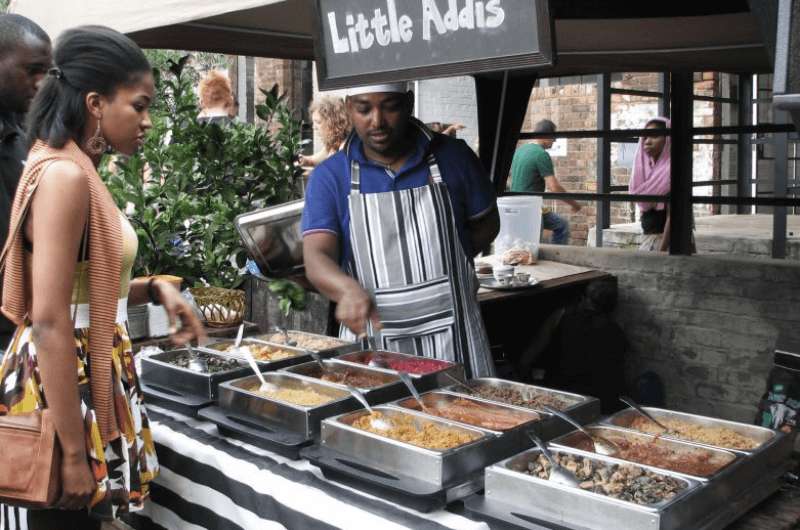
Market on Main in Maboneng—one of the best spots to explore Johannesburg’s creative side.
Put on your suspenders and colorful socks; it’s time to visit the hipster neighborhood of Maboneng, one of the most creative corners of downtown Johannesburg. It’s cool, it’s arty, it’s trendy! If alternative and independent are adjectives you like, Maboneng is the place for you.
Maboneng is a place to chillax the day away and experience Johannesburg’s vibrant culture and lifestyle.
Think dozens of restaurants, quirky cafés, boutiques selling all kinds of weird (but interesting) stuff, factories turned into studios and galleries, concerts. It’s also a great area for a walking tour if you want to explore the neighborhood slowly, especially around the lively and well-lit areas of Fox Street. You can almost feel the atmosphere, right?
If you can, visit Maboneng on a Sunday for the weekly market called Market on Main. You’ll be able to shop for everything from flowers and produce to vintage and design products, but mostly, you can absorb the vibe and people watch with a good coffee or a regional dish from one of the sellers.
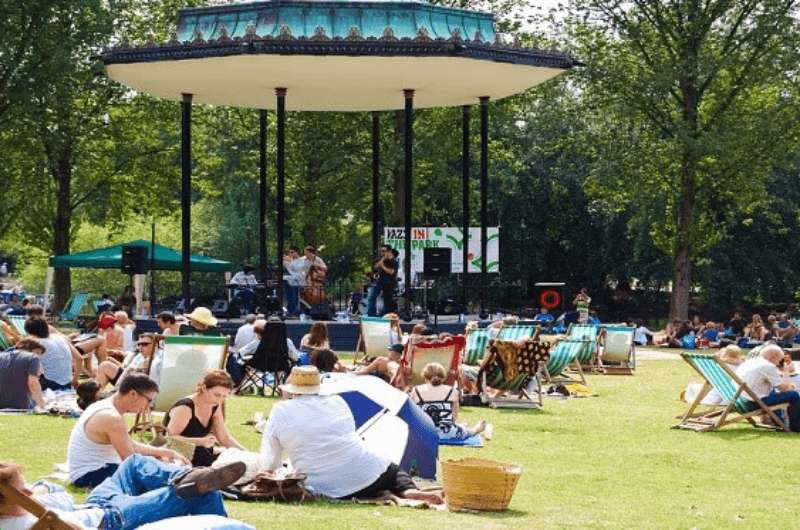
Jazz on the Lake
I don’t know about you, but I think it’s time for a breather! Some fresh air and a nice walk sound about right. Or maybe you aren’t into the hipster vibe that is the Maboneng district, but still want to hang out and see some real Jozi life?
Zoo Lake Park is where locals gather for picnics, jogs, to walk their dogs and kids, and row their boats on the lake. You can too! It’s BYOK (bring your own kid), but you can definitely buy a basket of goodies to eat and rent a little blue boat and join in on the fun. There are two restaurants/cafes in the park as well.
To really experience the park as the locals do, try to visit during one of the many events: concerts, art shows, the annual charity event Carols by Candlelight held in December, and the hugely popular Jazz on the Lake that takes place every September.
Fun fact: It is dubbed “The people’s park”, and when the founders of Johannesburg gifted it to the city, they did so under the condition that it would remain open to the public, specifically to people of all races. This was quite forward-thinking for 1904.
All right, now you’ve rested and rowed in the park, it’s time for the best Johannesburg day trips.
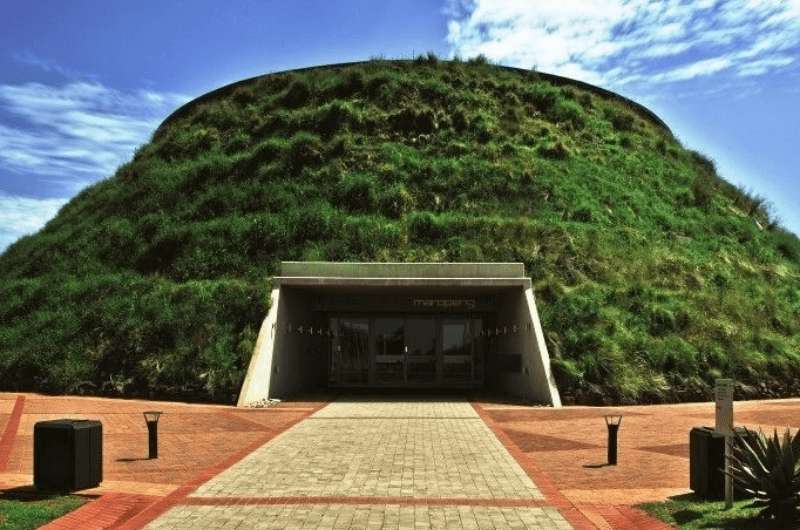
The grassy mound entrance to the Maropeng Visitor Centre at the Cradle of Humankind, about an hour from Johannesburg
You can learn a lot about South African history in Johannesburg. But how much do you know about the history of humankind?
The Cradle of Humankind is a UNESCO Heritage Site and an important paleoanthropological site about 1 hour out of Johannesburg. A large number of some of the oldest hominin fossils have been found here, including Mrs. Ples, the most intact pre-human skull, and Little Foot, a nearly complete skeleton, both over 2 million years old. They were found in the Sterkfontein Caves, where paleoanthropological work still continues to this day. The caves used to be coral reefs growing in a shallow sea and can now be visited as part of a tour.
If you want to add more wildlife to your trip, the nearby Lion Park is another popular stop in the area. It is important to realize that the area is huge and you will need your own car to get between the individual sites. If you want to turn it into a fuller day out, some travelers combine the visit with Lesedi Cultural Village nearby.
The Maropeng Visitor Centre is a great place to start, with some amazing discoveries on display and interactive exhibitions to make it fun and interesting. Plus, the entrance is a grassy mound that could be straight out of Hobbiton!
At the Sterkfontein Caves, you will first see the museum and then be taken on a tour of the actual caves. During this walk (bring good shoes and expect a lot of stairs!), a local guide will tell you all about Mrs. Ples and Little Foot, both of which were discovered in the caves decades ago.

Why hello there!
If you don’t have a lot of time in South Africa or are arriving via Johannesburg Airport, Pilanesberg Nature Reserve is only 2.5 hours away from Jozi and can make a great day trip—especially if you can’t make it all the way to Kruger National Park.
The reserve functions much like a classic African safari park, where you can drive through and spot wildlife in their natural habitat. Seeing elephants, rhinos, and lions roaming freely can be an unforgettable experience.
Nearby reserves in the region are also known for rare white lions, which are occasionally seen in this part of South Africa.
The park also sits close to Sun City, a large resort complex known for casinos, hotels, and golf courses.
You can still see the big 5 there; the park is home to the typical brown lions found across southern Africa. and sometimes even spot wild dogs, one of the rarest predators in South Africa.
Accommodation is more affordable here than in other safaris in the country, if you want to extend your day trip to an overnight trip.
The game reserve is located in a volcanic crater, and you can either self-drive or take a tour. They do 1- to 5- day tours, so there is definitely a lot to see. Most organized tours include hotel pick-up and drop-off in Johannesburg.
There is even a black rhino reserve on the northwest side of Pilanesberg. It has a separate entrance. Since the animals are free to roam throughout the park, though, you can still spot the big 5 even here in the rhino corner. One of the accommodation options that is worth a look is the Black Rhino Game Lodge.
And don’t forget to visit the Pilanesberg Centre, which is in the heart of the park, for some coffee and souvenirs, plus a great viewing deck.
You could spend a week in Johannesburg and never get bored. Many other travelers only briefly visit Johannesburg on their way to other parts of South Africa, but this vibrant city has plenty to offer if you give it time.
If you have extra time, you can also take a short trip to Pretoria to see the famous Union Buildings.
You probably won’t, because there are so many things to see in South Africa and you don’t have a 6-week vacation, but just sayin’, you could. It doesn’t have a couple of oceans like Cape Town or the spectacular hiking of the Blyde River or Drakensberg, but it has a lot of trees! They even turn purple in September! Just kidding.
Since you read this article, you know there is so much more to Jozi than that. It really is a fascinating city with top attractions once you give it a chance. So do not hesitate and visit Johannesburg asap. :)
This post contains affiliate links. If you make a booking through one of my links, I may earn a small commission—at no additional cost to you. Thank you for your support!


Hi, I’m Jan. I travel fast and intensely, whether I’m exploring the buzz of Tokyo in 3 days or road-tripping through mountains and beaches on a 3-week Thailand adventure. And no matter where I am, you’ll always find me in a comfortable hotel at night and eating the best food.
If that sounds like your kind of journey, hop on board, and let’s explore the world together!
I started this blog after realizing how tough it can be to find reliable, authentic travel info. You wouldn’t believe how many “travel bloggers” never even visit the places they write about! On Next Level of Travel, you can count on my full honesty and insights drawn from my firsthand experiences.
Here’s the deal: not every destination is all superlatives and unicorns. I’ll let you know if a tourist attraction isn’t worth your time, like skipping overrated stops in my 2-week Spain itinerary. And when I find something truly special—like the perfect mix of culture and nature in Cape Town—you can trust that it’s worth adding to your itinerary.


Comments | Thoughts? Give us a shout!